
Designing Hospital Central Sterilization Service Department (CSSD)
Sterifast / Service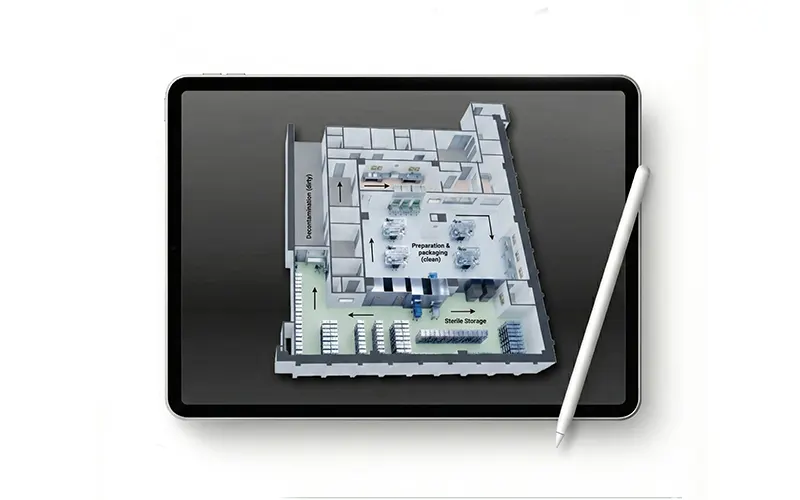
The design of the Central Sterilization Service Department (CSSD) in hospitals must adhere to strict international and national standards to ensure patient and staff safety while preventing hospital-acquired infections through unidirectional workflow principles.
Segregation of Areas
The CSSD is divided into three physically distinct zones separated by full-height partitions to prevent cross-contamination:
- Decontamination Area (Dirty Zone): For receiving and cleaning contaminated instruments.
- Preparation & Packaging Area (Clean Zone): For inspection and preparations.
- Sterile Storage Area (Sterile Zone): For distributing sterilized inventory.
Environmental Engineering (HVAC)
A properly designed HVAC system with controlled pressure gradients is essential for maintaining aseptic conditions:
- Negative Pressure: In the decontamination area to contain airborne bio-burden.
- Positive Pressure: In the sterile area to prevent external contamination.
- Temperature Control: 23-24°C for clean zones; 16-18°C for decontamination zones.
Surfaces and Infrastructure
All walls, floors, and ceilings must be constructed from seamless, non-porous materials. Lighting must be adequate for precise instrument handling, ensuring that every detail is visible during inspection.
Global Standard Compliance
Our designs strictly follow leading global benchmarks to guarantee safety and efficiency:
- ISO 14644: Cleanroom and controlled environment requirements.
- HTM 01-01: Sterilization management in healthcare facilities.
- CDC Guidelines: Infection prevention and sterilization best practices.
Shelving and Storage Optimization
Implementing modern, standardized storage solutions enhances accessibility, organization, and ensures the long-term maintenance of sterilization integrity for all medical devices.